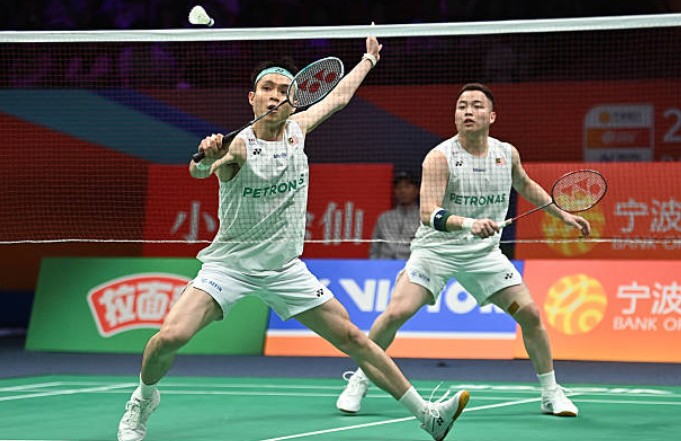
Ningbo: Malaysia’s campaign at the Badminton Asia Championships (BAC) 2026 came to a disappointing end after top men’s doubles pair Aaron Chia and Soh Wooi Yik were knocked out in the quarterfinals, ending hopes of a title defense in Ningbo, China.
The world No. 2 duo fell to South Korea’s Kang Min Hyuk and Ki Dong Ju in a hard-fought three-game battle, 19-21, 28-26, 13-21, in a match that lasted over 80 minutes at the Ningbo Olympic Sports Center.
The defeat not only ended Aaron and Wooi Yik’s title defense but also confirmed that Malaysia would have no representatives in the semifinals across all events — a significant setback for the national badminton contingent.
A Tight Battle Decided by Fine Margins
The match began with both pairs trading points in a closely contested opening game. Despite holding a mid-game lead, Aaron and Wooi Yik were unable to capitalize, allowing the Korean pair to edge ahead and take the first game 21-19.
The second game proved to be the turning point of the match, as both pairs pushed each other to the limit in a tense back-and-forth exchange. Showing resilience under pressure, the Malaysian duo saved crucial points and eventually closed the game 28-26 to force a decider.
However, the momentum did not carry into the third game. A series of unforced errors at key moments allowed Kang and Ki to pull away, establishing a decisive lead before sealing the match 21-13.
The Korean pair’s composure and consistency ultimately proved to be the difference, as they capitalized on opportunities while minimizing mistakes in the closing stages.
Aaron Reflects on Costly Errors
Following the match, Aaron Chia acknowledged that small mistakes at critical moments played a major role in the defeat.
“We had chances, especially in the first game when we were leading, but we made some simple errors,” he said. “In the third game, the mistakes came again, and it made it difficult to recover.”
Despite entering the match without significant pressure, the disappointment of failing to defend their title was evident.
“We came in with a positive mindset, but of course, we are disappointed with the result,” Aaron added.
Malaysia’s Campaign Ends Across All Events
The loss marked the end of Malaysia’s challenge at the Badminton Asia Championships, with no players advancing beyond the quarterfinal stage.
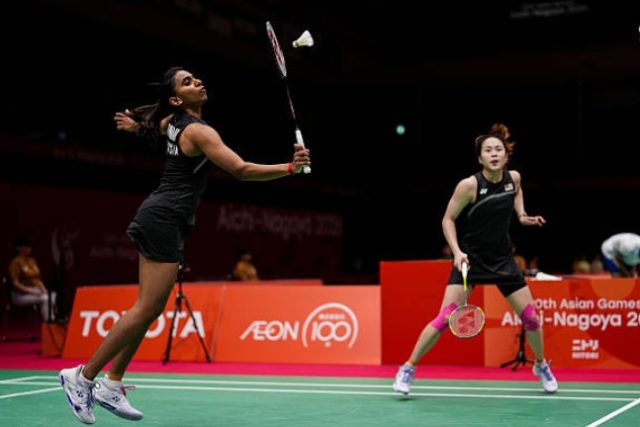
Earlier, Malaysia’s women’s doubles pair Pearly Tan and Thinaah Muralitharan were eliminated by China’s Li Yi Jing and Luo Xu Min in straight games, 13-21, 15-21.
The Chinese pair controlled the match with sharp attacking play and strong defensive coverage, underlining China’s continued dominance in women’s doubles badminton.
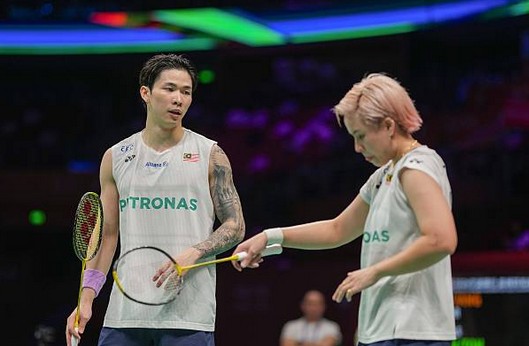
In mixed doubles, Malaysia’s Chen Tang Jie and Toh Ee Wei also saw their campaign come to an end after losing to South Korea’s Kim Jae Hyeon and Jang Ha Jeong, 19-21, 17-21.
Despite showing flashes of brilliance, the Malaysian pair struggled to maintain consistency against the disciplined Korean duo.
Toh Ee Wei later emphasized that her focus remained on performance, dismissing any external factors as an excuse for the defeat.
China and Korea Continue to Set the Pace
The results highlight the growing strength of China and South Korea in the current badminton landscape, particularly in doubles events.
China’s presence remains especially strong, with multiple pairs advancing deep into the tournament and showcasing their depth and tactical discipline.
Meanwhile, South Korea’s success in eliminating top-seeded pairs underscores their ability to perform under pressure on the biggest stages.
These developments reflect the increasingly competitive nature of badminton, where even top-ranked players must maintain near-perfect execution to secure victories.
Lessons Ahead for Malaysian Badminton
For Malaysia, the early exit at BAC 2026 serves as a reminder of the fine margins at elite level badminton.
While the performances showed promise, particularly in closely contested matches, converting key moments into victories remains the biggest challenge.
As the season progresses, the focus will shift toward upcoming tournaments, where Malaysian players will look to regroup, refine their strategies, and return stronger.
Despite the setback, the experience gained from high-intensity matches against top Asian rivals will be crucial in preparing for future competitions.
For fans, the results may be disappointing, but they also highlight the evolving and highly competitive nature of modern badminton — where every point matters, and every match can shift the balance of power.