HANGZHOU, November 25, 2026 – China will have seven representatives at the 2026 HSBC BWF World Tour Finals, but for the first time in 11 years, the country will have no men’s singles player competing at badminton’s season-ending championship.
The absence highlights a worrying decline in China’s men’s singles programme, particularly as the Chinese Badminton Association announced the appointment of veteran coach Tian Bingyi as national head coach on the same day the new coaching arrangements were unveiled.
The 2026 World Tour Finals qualifying field was completed following the Hong Kong Open, with eight players or pairs qualifying in each of the five disciplines. China secured two places in women’s singles, two in men’s doubles, one in women’s doubles and two in mixed doubles. However, the men’s singles category will have no Chinese representation.
China’s Men’s Singles Decline Reaches a New Low
The eight men’s singles qualifiers are France’s Christo Popov and Alex Lanier, Denmark’s Anders Antonsen, Indonesia’s Alwi Farhan, Thailand’s Kunlavut Vitidsarn, Canada’s Victor Lai, India’s Lakshya Sen and Chinese Taipei’s Chou Tien-chen.
Notably, Lanier enters the competition as the reigning world champion, while Popov returns as the defending World Tour Finals champion. No Chinese player made the cut.
The last time China failed to qualify a men’s singles representative was in 2015. The contrast with last season is particularly striking, as Shi Yuqi and Li Shifeng both qualified for the 2025 Finals, with Shi reaching the semifinals.
China’s disappointing 2026 campaign is also reflected in its title record. Chinese men’s singles players collected just four titles across the BWF World Tour and lower-tier international circuit this season.
Li Shifeng won the Malaysia Masters (Super 500), Zhu Xuanchen claimed the Korea Masters (Super 300), Hu Zhe’an captured the Macau Open (Super 300), and Sun Chaorui won the Ruichang Masters (Super 100).
More concerning, China failed to win a men’s singles title at any Super 750 or Super 1000 tournament during the season. Hu Zhe’an was the highest-ranked Chinese player in the World Tour Finals standings, finishing outside the top 20, followed by Shi Yuqi, Li Shifeng and Weng Hongyang.
The figures point to a broader problem rather than an isolated dip in form. China has struggled to establish a sufficiently strong second generation of men’s singles players capable of consistently challenging the world’s leading competitors.
Tian Bingyi Takes Charge as China Reshapes Coaching Structure
In a significant development, the Chinese Badminton Association announced on November 24 that 63-year-old Tian Bingyi would become the national team’s new head coach, taking responsibility for preparations for the 2028 Los Angeles Olympics.
The appointment also marks the return of a central head-coach position. Following Li Yongbo’s departure in 2017, China operated under a discipline-based coaching structure, with responsibility divided between the singles and doubles programmes.
Tian brings an exceptional background in international badminton. As a player, he partnered Li Yongbo to win the 1987 and 1989 World Championships men’s doubles titles, three consecutive Thomas Cup titles in 1986, 1988 and 1990, and men’s doubles bronze at the 1992 Barcelona Olympics.
After retiring, Tian became a leading figure in China’s coaching programme, particularly in women’s doubles. He was involved in developing generations of Olympic champions, including Ge Fei and Gu Jun, Yang Wei and Zhang Jiewen, and Du Jing and Yu Yang.
He subsequently served as national team deputy head coach and has experience overseeing China’s first team, second team and youth programme.
The association also appointed two-time Olympic champion Zhang Nan to the national coaching team. Zhang won mixed doubles gold at the 2012 London Olympics with Zhao Yunlei and men’s doubles gold at the 2016 Rio Olympics with Fu Haifeng. He later coached the Beijing women’s badminton team to championship and runner-up finishes in national competitions.
The two appointments are intended to strengthen China’s coaching resources as the country prepares for the next Olympic cycle.
China’s 14-Week Winter Training Camp Has a New Priority
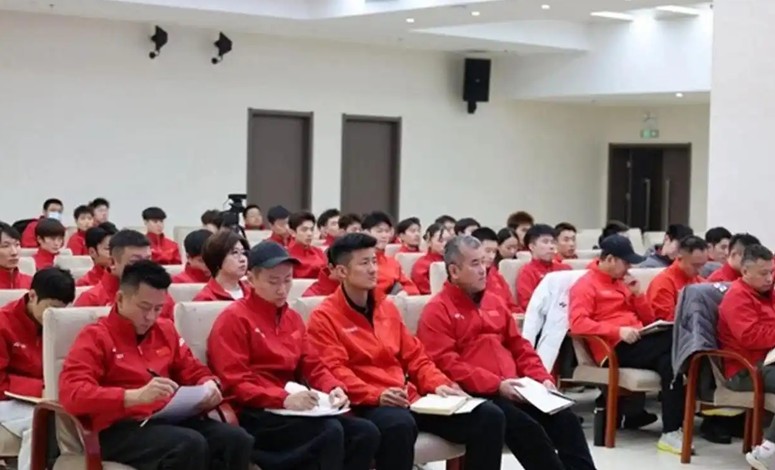
The national team’s winter training programme began on November 24 and will run until February 28, 2027, covering 14 weeks across three phases: adjustment, improvement and strengthening.
Among the six priorities announced by the Chinese Badminton Association, one stands out: studying how to succeed under badminton’s incoming 15-point scoring system.
The BWF approved the new three-game, 15-point format at its Annual General Meeting in Horsens, Denmark, on April 25, 2026. The proposal received 198 votes in favour and 43 against, with implementation scheduled for January 4, 2027.
Under the new format, games will be played to 15 points, with a two-point winning margin required from 14-all and a maximum score of 21. The mid-game interval and change of ends in the deciding game will move from 11 points to eight.
With the new system taking effect in just under six weeks from the start of China’s winter camp, adapting to the shorter scoring format will be an immediate priority for the coaching staff.
The reduced scoring target also means players will have fewer points available to recover from a slow start. China’s ability to adapt its training, match preparation and competitive approach could therefore become an important factor in the coming season.
China’s Seven World Tour Finals Qualifiers
Despite the absence of a men’s singles representative, China remains competitive in the doubles disciplines and women’s singles.
Women’s Singles: Wang Zhiyi and Chen Yufei.
Men’s Doubles: Liang Weikeng/Wang Chang and Chen Boyang/Liu Yi.
Women’s Doubles: Liu Shengshu/Tan Ning.
Mixed Doubles: Feng Yanzhe/Huang Dongping and Jiang Zhenbang/Wei Yaxin.
Mixed doubles remains China’s strongest discipline in terms of depth, with Feng/Huang and Jiang/Wei occupying two of the leading positions in the international rankings. However, the country’s women’s doubles representation is particularly thin, with Liu/Tan the only Chinese pair to qualify.
Malaysia Sends Two Pairs to Hangzhou
Malaysia will have two representatives at the 2026 World Tour Finals, with men’s doubles combination Goh Sze Fei/Nur Izzuddin and women’s doubles pair Pearly Tan/Thinaah Muralitharan both qualifying.
Goh and Nur Izzuddin will face a competitive men’s doubles field that includes South Korea’s Kim Won-ho/Seo Seung-jae, Japan’s Takuro Hoki/Yugo Kobayashi and Indonesia’s Fajar Alfian/Muhammad Shohibul Fikri.
Pearly and Thinaah will also face strong opposition in women’s doubles, including China’s Liu Shengshu/Tan Ning, Japan’s Yuki Fukushima/Mayu Matsumoto and South Korea’s Baek Ha-na/Lee So-hee.
An Se-young Chases Another Historic Season
In women’s singles, South Korea’s An Se-young will headline a field that includes Japan’s Akane Yamaguchi, China’s Wang Zhiyi and Chen Yufei, and India’s Pusarla V Sindhu.
An Se-young has already collected 11 titles this season and will have an opportunity to reach an unprecedented 12 tournament victories in a single year if she wins in Hangzhou.
Thailand’s Ratchanok Intanon has also secured a record 11th World Tour Finals qualification, adding another milestone to an impressive international career.
Hangzhou to Host US$3.5 Million Season Finale
The 2026 HSBC BWF World Tour Finals will take place in Hangzhou, China, from December 9 to 13, featuring the season’s eight leading players or pairs in each discipline.
The tournament carries a total prize pool of US$3.5 million, making it the richest event on the 2026 BWF World Tour calendar.
For China, however, the biggest story heading into its home season finale is not the seven qualifying places but the one discipline in which it has no representative.
Tian Bingyi’s appointment comes at a crucial moment. Rebuilding the men’s singles programme, strengthening the depth of the women’s events and adapting to the incoming scoring system will all test his leadership during the road to Los Angeles 2028.
China remains one of badminton’s traditional powerhouses, but its men’s singles absence at the World Tour Finals is a reminder that its historical reputation alone will not guarantee future success. The rebuilding process starts now.