Ningbo: Malaysia’s badminton campaign at the 2026 Badminton Asia Championships (BAC) in Ningbo has come under scrutiny, with national doubles coaching director Rexy Mainaky openly criticizing the performances of several top pairs following their quarterfinal exits.
Rexy did not hold back in his assessment, pointing to inconsistent play and a failure to execute core strengths as key reasons behind Malaysia’s inability to progress beyond the last eight.
Pearly Tan-Thinaah Fall Short of Expectations
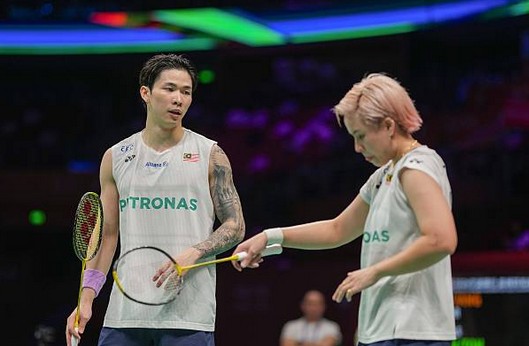
Malaysia’s world No. 2 women’s doubles pair Pearly Tan and Thinaah Muralitharan were among those singled out, with Rexy expressing disappointment over what he described as a passive and uncharacteristic display.
The duo were eliminated in straight games by China’s Li Yi Jing and Luo Xu Min, losing 13-21, 15-21 in a match where they struggled to assert control.
“Their game was too negative,” Rexy noted. “Rotation, attacking play — these are supposed to be their strengths, but we didn’t see that at all in this tournament.”
Known for their aggressive style and fast-paced transitions, Pearly and Thinaah appeared unable to impose their usual rhythm, allowing their Chinese opponents to dictate the pace from start to finish.
Chen Tang Jie-Toh Ee Wei Lacked Structure
Mixed doubles pair Chen Tang Jie and Toh Ee Wei also came under criticism after their defeat to South Korea’s Kim Jae Hyeon and Jang Ha Jeong.
The Malaysian pair lost 19-21, 17-21, with Rexy highlighting a lack of structure and cohesion in their play.
“Tang Jie looked very unsettled. The overall game plan just didn’t come together,” he said.
Despite flashes of quality, the pair struggled to maintain consistency throughout the match, often losing control during crucial rally exchanges.
The loss was particularly disappointing given their recent rise in the rankings and growing reputation as one of Malaysia’s most promising mixed doubles combinations.
Aaron Chia-Soh Wooi Yik Praised Despite Loss
In contrast, Rexy took a more balanced view when discussing the defeat of men’s doubles pair Aaron Chia and Soh Wooi Yik, who were eliminated in a hard-fought three-game match against South Korea’s Kang Min Hyuk and Ki Dong Ju.
The Malaysians lost 19-21, 28-26, 13-21, ending their title defense at the quarterfinal stage.
Rexy acknowledged that the Korean pair delivered a near-flawless performance, combining aggressive attacking play with disciplined rotation.
“Today, Korea played extremely well. They were more aggressive, and their rotation was very solid,” he said.
While Aaron and Wooi Yik showed resilience — particularly in the second game where they saved multiple game points — they were ultimately undone by a higher error count in the decisive third game.
Key Issue: Inconsistency at Critical Moments
A recurring theme in Rexy’s analysis was inconsistency, particularly during high-pressure moments.
At the elite level of badminton, where margins are extremely tight, even small lapses can determine the outcome of matches. According to Rexy, Malaysia’s top pairs were unable to maintain their level when it mattered most.
This was evident in both the women’s and mixed doubles matches, where momentum shifts were not effectively managed.
China and Korea Set the Benchmark
The performances of China and South Korea at the tournament further highlighted the gap Malaysia needs to close.
Chinese pairs, particularly in women’s doubles, demonstrated superior control, tactical discipline, and consistency — qualities that allowed them to dominate matches with minimal errors.
Meanwhile, South Korea’s doubles teams showcased exceptional coordination and attacking efficiency, proving capable of defeating even higher-ranked opponents.
These performances underline the current standard at the top of Asian badminton, where execution and mental strength are just as important as technical ability.
What’s Next for Malaysia?
Looking ahead, the focus for Malaysia will be on addressing these inconsistencies and rediscovering their core strengths.
For Pearly-Thinaah, that means returning to their aggressive identity, while Chen Tang Jie-Toh Ee Wei will need to refine their tactical structure and on-court communication.
Aaron Chia-Soh Wooi Yik, despite their loss, remain among the world’s top pairs and will look to bounce back in upcoming tournaments.
The Badminton Asia Championships may not have delivered the results Malaysia hoped for, but the lessons learned could prove crucial as the season progresses.
In modern badminton, where competition continues to intensify, adaptability and consistency will ultimately determine which pairs rise to the top.